›

Picking a life insurance policy on your own can be tough, since many choices look the same. But the right life insurance can give your family real help if something happens to you. This guide goes over how a life insurance policy works. It shows who should get one and what it can cover. The guide also explains the difference between getting life insurance on your own or from your job.
You will learn about different types of insurance policies. There is info on costs, mistakes people make, and smart ways to look for life insurance in Canada. This makes it easy to compare options without feeling stressed.

An individual life insurance policy is coverage you buy for yourself. You pick the coverage amount, policy type, and the person who will get the benefit. If you pass away while the policy is active, the insurance company gives a death benefit to whoever you chose.
This is important because life insurance from other places can be limited. A personal insurance policy lets you focus on your family, your debts, your home, and your goals. It gives you more control, instead of just depending on basic insurance coverage through your job or a group plan.
Not everyone needs the same life insurance coverage. But many people in Canada can get real help from an individual life insurance policy. If someone counts on your income, your insurance policy can step in when you can't be there. When you have a loan, house payment, or other big bills, your life insurance can support your family with these things.
You may need life insurance if you are a parent, have a husband or wife, or want help for final expenses. A personal insurance policy works with estate planning goals too, and it gives your surviving spouse more time to breathe and plan. The amount of coverage also helps when your workplace insurance policy doesn’t pay much.
The coverage amount that works best for you depends on your life and what you want long term, not just some rule. Insurance companies will check your details, but start by thinking of your own needs, your budget, any debts you have, what you have saved, and where you want to go in the future before getting a life insurance policy.
Life insurance becomes more important as you get more responsibilities. If you are a single person with no one who depends on you, you may not need much life insurance. But if you have children, share bills, or pay for a home loan, you need more coverage. Your needs can change quickly after a big event in your life.
Many people want to know when to buy life insurance. Most of the time, the answer is to get it before the money stress gets bigger. If you live in Canada and have a family, you will need family life insurance more when others depend on you.
These key moments can help you figure out how much life insurance fits your life right now. You do not have to wait years to make this important choice.
A personal life insurance policy is there to help bring some financial security to the people you care about most. When you pass away, if the insurance policy is still active, your beneficiary will get the death benefit. This money can help your family in a tough time.
For many people, the biggest help they get from life insurance is money to keep up with bills. If there is a surviving spouse, they could use the money for things like rent, food, child care, and other payments. The payout from the life insurance policy can also take care of final expenses, such as funeral costs and any bills left after you go, so your family does not have to pay it all from their own funds.
That’s the reason why life insurance benefits are so important for families in Canada. These benefits are more about keeping things working for your loved ones, not just about feelings. If you have the right amount of life insurance, you can help with daily life, take away money worries, and protect all that you have built.

A life insurance policy is a deal between you and the insurance company. You pick the coverage amount, say who will get the money, and pay for the insurance to keep it going. There are two types: term or permanent, so you choose how long you want the life insurance to last.
After the company says yes to your application, your coverage starts as the life insurance policy says. If you die while your insurance is active, the insurer gives the death benefit to the person or people you picked. The next sections tell you more about each part.
The application process usually begins when you give your basic personal and health details. For some policies, you have to go through a medical exam so the insurance company can know the risk they are taking. Others, like simplified issue or guaranteed issue coverage, do not need a medical exam. But these often come with a lower coverage amount and higher prices.
Once you are approved, you start making premium payments each month or year. These payments keep your policy going. For many term plans, your premium payments stay the same during the term. Some permanent plans may let you be more flexible with what you pay, depending on how the policy is set up.
If the insured person passes away while the policy is active, the insurance company will check the claim and then pay out the death benefit to the person or people you chose. The payout can go to one person, more than one person by percentage, or a charity, based on your choice during the application process.
A good insurance policy can help with much more than just one bill. Life insurance coverage is there to help your family with short term costs and keep your long term plans safe. How you use it depends on what your household needs and the coverage amount you pick.
Many Canadians choose personal life insurance plans because they want something useful if something happens. This is one thing most families in Canada ask about first when looking at life insurance, what can the money help pay for?
If you have more responsibilities, you should think a bit more about what the insurance coverage needs to protect.
Sometimes you know you need insurance coverage when you think about what happens in real life. A strong life insurance policy can help a family who no longer has income, needs to pay final expenses, or has to protect long-term plans when the insured person is gone.
The best individual life insurance policy in Canada changes for each family. One family might need money just while the children are young. Another may need lifetime coverage to reach estate planning goals. So, you have to compare the insurance policy type and the amount.
Group life insurance through work can be good to start with. It is often low cost. Some jobs give a small group life coverage at no cost to you. But group life from your employer may limit how much coverage you get. You may also not have much say in how it works.
An individual life insurance policy lets you choose what you need. You pick the type, the coverage amount, and the person who gets the benefits. This way, you can line up your life insurance with what you want for you and your family. That is important if you want your insurance policy to change as your life does.
The main thing that separates group life insurance from individual life insurance is choice. In group plans, the coverage is set up for many workers. The payout can be smaller. Your options may also be limited. Often, you get only one type of policy or a few choices.
In an individual plan, you pick what fits your goals. You get to decide if you want a term or a permanent policy. You can set a bigger coverage amount if you need one. You get to build your plan around your family, your house, your bills, or estate planning.

Portability means you could keep your coverage if you leave a job. Group life insurance does not always give you this option. If your employer’s plan is not portable, your insurance policy may stop when your job ends.
This is one reason why individual life insurance can be simpler to handle in the long run. You own the policy, not your workplace. If things change and you switch jobs, your coverage does not depend on your boss keeping the group life plan.
You can look at your coverage amount again if life changes. You might want more coverage if you have a new child, a bigger home loan, or new plans with money. Personal life insurance gives you a more steady base if you need to look at your needs again.
Employer group life can help, but on its own, it may not be all you need. Many group life insurance plans only give you a basic amount of coverage. This may be good for short term needs. But if your family counts on what you earn, this amount of coverage may not be enough in the long run.
Take time to go over your insurance policy. Match it to what you really owe and need to cover. Think about debts. Think about mortgage size. Think about your children, and how long your family counts on your help. That is where you may find gaps in your life insurance.
You may need extra life insurance if:
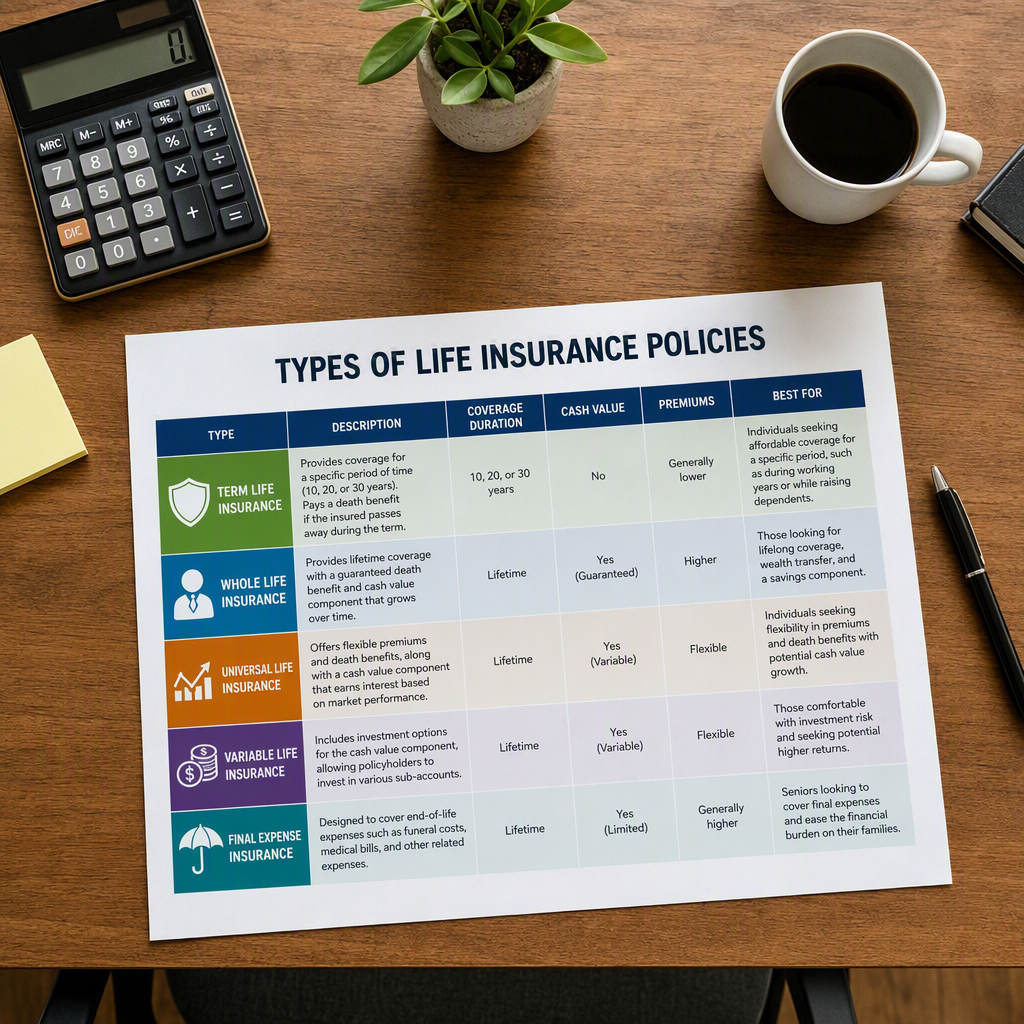
There are two main types of life insurance policies. These are term life and permanent life insurance. It is good to know the difference between them. This helps you pick what fits your timeline, how much you can spend, and your goals. If you want to compare an individual life insurance Canada plan, this is the first thing to do.
Term life insurance gives you coverage for a set number of years. Permanent life insurance gives you coverage that can last your entire life. Permanent coverage may also build cash value over time. The next parts will show you the main types of life insurance in simple ways. This helps you compare them better.
Term life insurance gives you insurance coverage for a set amount of time, like 10, 20, or 30 years. If you die during that period, your beneficiary gets the death benefit. If that time ends and you want to keep your coverage, you often need to buy a new policy.
For most people, this type of policy is a good choice because the payments are usually lower than permanent life insurance. This can help families, people with mortgages, or anyone who needs strong life insurance for a few years. It is good for times in life when you have the most to take care of.
Term life insurance is often picked to cover needs for a certain period. It can last until kids are older, debts go down, or your retirement savings get strong. Many looking for term life insurance in Canada also check if there is a way to change their term life policy to permanent coverage later on.
Permanent life insurance is made to cover you for your whole life. If you keep paying for the policy the right way, it will stay in place and pay the death benefit when the insured person passes away. Whole life insurance and universal life insurance are both types of permanent coverage.
Whole life insurance has level premium payments. This means you pay the same amount each time. The death benefit is guaranteed and so is the cash value growth. People can use whole life insurance for covering final expenses, estate planning, or passing on wealth. Many in Canada choose whole life insurance when they want stable coverage for many years.
Universal life insurance is a kind of permanent life insurance that offers flexible coverage. It gives lifetime protection and has a cash value component. You can change premium payments within the policy limits. This choice may be better for people in Canada who want flexibility if their income goes up or down, or who want their cash value to grow faster.
Choosing between whole life insurance and term life insurance is about what you want the policy to do for you. This is what the term vs whole life insurance Canada choice is really about. One type is often less money at first and covers you for a set time, but the other is meant to cover you for your whole life and can build cash value as time goes on.
You should start by thinking about your budget, the time you need coverage, and what your money goals are. No type of policy works best for everyone. The amount of life insurance that fits you comes down to your age, health, how much you make, your debts, your savings, the people who count on you, and how much life insurance will be right for you over time.
Ask yourself:
A lot of people in Canada want to know how much life insurance they should have. There is no single answer that works for everyone. The coverage amount you need depends on how much financial protection your family will need if something happens to you and your income is lost.
To figure out how much life insurance you need, you have to think about a few things. Look at your income, your debts, the balance left on your mortgage, any final costs, and your future goals. The amount of coverage should help the people who count on you. At the same time, it should not cost too much for your budget. The next parts will show you a simple way to think about your coverage amount and how to choose the right one.
Start with the most basic question. If you were to go, how much money would your family need each month? This helps you think of a coverage amount that can replace income. It is not just for one time bills. This is one of the best ways to see the real need.
Look at your house costs, food, costs for children, utilities, and other regular bills. Also, think about how long your family will need this help. Some families may need it until kids grow up. Others may need it until retirement savings or other help are there.
The insured person should also look at savings and other money they already have. If you have assets to help your family, you might need less coverage. If you do not have much backup, you may want more protection. This will give your family a safer money cushion.
Income replacement is just one part of what you need. Your insurance coverage should take into account any big debts and future costs too. If there is still a lot to pay after someone dies, a family can get into trouble fast, especially if their income goes down.
It is smart to look ahead rather than only at today’s bills. The amount of coverage you get should cover things that do not go away soon. That is why having the right amount for your mortgage and covering your children’s needs are key when you plan.
Common things to cover include:
A good estimate for what you need helps you pick a policy that works for your family.
Your beneficiary is the person or group who gets the death benefit. You can pick one person, many people and list percentages, or even choose a good cause. Picking the right one is important. This part is basic to how your insurance policy really works.
A lot of people pick a surviving spouse, their kids, or both as their beneficiary. The right pick is about your family setup and your estate planning needs. If there is more than one person who needs you, it makes sense to split the coverage amount by percentage.
This choice often leads to questions about life insurance beneficiary rules in Canada. It is a good idea to keep your beneficiary list current. Check to see if you need to update it when big life changes happen. A policy that works for your family now might need changes later if things change for you.
Life insurance costs depend on risk, the type of policy, and how much protection you want. Insurers look at your age, health status, if you smoke, and your lifestyle. They also think about the kind of policy and the coverage amount that you pick.
So, the cost of life insurance can change a lot between people. Term plans are usually cheaper than permanent coverage, but your details play a big part. The sections below show the main things that impact life insurance rates in Canada.
Age is a big part of what you pay for life insurance. If you apply when you are younger, you pay less. This is because insurance companies look at younger people as not risky. When you get older, the cost goes up. This is why many people want to get life insurance sooner and not wait.
Your health status matters in life insurance costs too. Insurance companies check your medical history, your family’s medical history, and how healthy you are now. Some life insurance policies want you to take a medical exam. Others do not. They use something called simplified issue or guaranteed issue instead. If you have health issues, your choices may change.
How you live your life affects what you pay as well. Smoking or using e-cigarettes can make your costs go up. So do things like how you drive, what job you have, and your general risk. That is why two people with the same policy type might see different premium quotes.
If you buy more coverage, you will usually pay more. A bigger coverage amount means there can be a bigger payout. Because of this, life insurance premiums go up as the protection gets larger. This is why it is good to think about what your family needs and what your budget can handle.
How long the life insurance lasts matters too. A longer term often will cost more than a shorter one. This is because the company has to cover you for more years. If you look at term life insurance Canada plans, you may see price changes for 10 year, 20 year, and 30 year options.
The type of policy is also important. Term insurance is often the least costly choice. That is because term life only lasts a set time and does not build cash value. Permanent coverage, like whole or universal life, usually costs more. That is because this kind of policy can last for life and may build cash value over time.
Yes, the good news is there are affordable life insurance plans for Canadians. The prices can be different from one insurance company to another, even when the coverage amount seems the same. For life insurance shoppers in Canada, it’s smart to look at the details and not just at what you pay.
A simple comparison of different plans can help you get coverage that fits your needs and still saves you money. You may want to check with direct insurance providers, reach out to an insurance agent, or try an online marketplace. Many people also search for life insurance broker near me when they want someone to help them face to face.
To get more value, try this:

A lot of people pick an insurance policy too fast or delay it because the choices seem hard to understand. This can give you a life insurance policy that may not fit your family, budget, or what you need in the long run. The best way is to compare well and ask clear questions.
Many problems happen when you choose the wrong coverage amount. Sometimes, people look only at life insurance costs. Others forget to check their insurance policy later. If you know about these issues, you can make a good choice the first time.
Buying too little coverage in your life insurance policy can hurt the financial protection for your family. If the money from the insurance policy does not pay for income loss, debts, and the basic needs, your loved ones might have to use their savings or make tough financial choices fast. This means the life insurance does not give the financial security it was supposed to give.
But if you buy too much coverage, the cost each month could be too high for you. If keeping up with the payments gets hard, the life insurance may not work well for you after some time. Your life insurance policy should help your life, not add new stress.
You need to find a balance. Think about the real costs your family might have, how long they will need help, and what you can pay for each month. A good estimate lets you avoid having not enough financial protection, and also not paying for more insurance than you need.
Low price can be good, but it is not the only thing you need to think about. An insurance policy that looks cheap may not be right for your family. If the type of insurance, policy type, term length, or coverage amount does not fit, it may not help you. If you save money now, it will not be worth it if the coverage amount does not work when you need it most.
You should look for value. Does the insurance policy’s type of insurance fit your needs and goals? Is the coverage amount enough to protect your family? Is the policy made for short-term needs or for long-term plans?
You should compare these key features:
Waiting too long to get life insurance can make it more pricey. Costs for a life insurance policy usually go up as you get older or if your health changes. If you wait, options may be fewer later on. If your family counts on your money, not having coverage could leave them without the financial protection they need.
You should also look at your life insurance policy when big events happen. Things like getting married, having new kids, taking on a bigger home loan, or changes in income can all shape the right coverage amount. An insurance policy you got earlier might not be good for your current situation.
Can you change your life insurance policy after you buy it? Most of the time, you can look over your life insurance and adjust or change your coverage amount to fit what you need at the time. It is smart to check it now and then. Don’t count on your old choice to always be right.
Getting a quote is just the start. If you want to compare an individual life insurance policy well, you need to look at the insurance coverage, the policy type, how long the term is, and how flexible it is. You also have to look at life insurance premiums. Two quotes may look the same, but they can give different value over time.
This is why many people in Canada compare life insurance policy options from different insurance companies before they pick one. A simple and clear plan can help you stay away from any surprises. It also helps you feel good and sure about the insurance policy you choose.
You can get life insurance quotes right from insurance companies. You can also get them from an insurance agent, or use online sites that let you compare plans. If you want to look at life insurance Canada choices without worry, Policy Ninja is a good place to start. You can check different options and find a life insurance plan that fits you.
For Canadians who need some help picking a policy type, PolicyNinja gives a simple way at https://www.policyninja.co/. This helps save time when you want to see term life insurance Canada and permanent life insurance Canada side by side.
Here are some good places to get help:
A simple process can help you find the right insurance policy. First, decide what the life insurance should do for your family. Know what you want it to cover. Next, look at all the policy types. Figure out how much coverage amount you need. Check prices from more than one provider. This way, you can pick based on facts, not guesses.
Then, you start the application process. You may be asked health questions. Some life insurance policies may ask for a medical exam. After you get approved, keep your policy details together. Look over your details again after you have big changes in your life.
A clear checklist can help you:
When you feel ready, compare individual life insurance policies and get a quote through Policy Ninja in a calm, practical way.
To sum up, picking the right life insurance policy matters when you want to keep your family safe and take care of your money in the future. You need to know the main types of coverage out there, like term and permanent life insurance.
This helps you choose an option that fits what you and your family need. Make sure to think about your family's needs, any debts you have, and what you may need to pay for later on. The coverage amount you choose should match these things.
Try not to buy too little life insurance or focus only on getting a low price without looking at what you get. It is a good idea to compare more than one insurance policy before you pick one. This helps you find a plan that works for you. If you want to protect your family in the best way, check out and compare options now. Get a quote through PolicyNinja so you can find the right life insurance policy for you and your loved ones and take away the guesswork.

Cindy David, CFP, CLU, FEA, TEP, is President & Estate Planning Advisor at Cindy David Financial Group Ltd. in Vancouver. A recognized leader in wealth management and estate planning, Cindy guides clients with strategic, tax-effective solutions while championing innovation and women’s leadership in the financial industry. She is the former Chair of the Conference for Advanced Life Underwriting (CALU) — Canada’s professional association for senior life insurance and financial advisors that advances education, advocacy, and best practices in advanced planning and public policy.


