


Nearly 1 in 4 Canadians have no life insurance at all, and another third say they do not have enough. That gap shows up at the worst possible time: after a death, when a family is trying to hold the mortgage, the groceries, and the kids' routines together on one income or none.
Term life insurance is the most affordable way to close that gap, and for most households under 60, it does the job better than any other policy type. This guide walks through how term life works in Canada, what it actually costs, and how to figure out the right coverage for your situation.

Term life insurance is a popular pick for families in Canada who want to save money but get good protection. This life insurance is easy to understand. It gives you insurance coverage for a set amount of time.
A term policy means your loved ones will get money if you pass away while the policy is active. Now let's look at the types of insurance and see why this option stands out.
Canadian life insurance splits into two main categories.
This covers you for a fixed period, typically 10, 20, or 30 years, with premiums locked in for the duration. If you die during the term, your beneficiaries receive the death benefit. If you outlive the term, the policy ends (or renews at a much higher rate).
Term is the most popular category in Canada because it costs a fraction of permanent coverage while handling the highest-risk years of most financial lives.
This covers you for your entire life, regardless of when you die, and builds a cash value component you can borrow against or withdraw. The two main subtypes are whole life (fixed premiums, guaranteed death benefit, predictable cash value growth) and universal life (flexible premiums, adjustable death benefit, and cash value tied to investment performance).
Permanent coverage typically costs 5 to 15 times more than equivalent term coverage, which is why it is usually reserved for estate planning, high-net-worth buyers, or families funding lifelong dependents.
Standalone products like critical illness insurance can be bought separately or added to a life policy as a rider, paying a lump sum on diagnosis of a covered condition.
The appeal of term life insurance comes down to two things: it is simple, and it is affordable. The policy has one job, paying your family a death benefit if you pass away during the term you chose. No cash value, no investment side, none of the complexity that comes with other types of coverage.
This simple way makes term life insurance a budget-friendly choice compared to permanent coverage. Permanent life insurance products last for your whole life and give savings on top, but the premium payments are a lot higher.
Here’s a quick comparison:
In the end, term life insurance helps you get the life insurance you need, while keeping the cost low and things easy to understand.
Getting term life insurance is easy. First, you pick the coverage amount (the money your loved ones will get if you pass away, also called the death benefit). Then, you need to choose your term length. The policy is usually active for 10, 20, or 30 years.
After you know the coverage amount and term length you want, you go through the application process with an insurance company. You will answer some questions about your health and daily habits. Your premium payments will stay the same the whole time. That way, you always know how much to pay.
If you die while the policy is still good, your family has to send in a claim. This helps them get the death benefit. If you use a life insurance calculator, you can find out how much coverage your family might need for their future.
Leading Canadian term life insurance companies offer several features to fit many different needs. One of the best parts for many people is affordable coverage. Because term insurance is set for a period of time, the premiums are much less than you would pay for a permanent policy. This means you can get a lot of protection without putting stress on your budget.
A lot of these life insurance companies also let you change your policy later. If you start with term life insurance, you have the choice to switch it to a permanent policy down the line. That way, if your needs change and you want coverage for life, you can make the switch, often without another medical exam.
Here are some things term insurance often includes:

When you choose a term life insurance company, quotes are only the starting point. The four factors that actually matter over a 20 or 30-year policy are financial strength, customer service quality, policy flexibility, and whether a good broker is guiding the decision. Let's look at each.
When you buy a life insurance policy, you’re signing up for a long-term plan. You want to know that the insurance company will be there to pay out when something happens. You want this peace of mind for the next five years, 25 years, or even longer. That's why it's so important to check the financial strength of the company first.
Look at the company’s history, what assets it owns, and what ratings it has from trusted credit agencies. Big names like Manulife, Canada Life, and Sun Life have been around for many years. They give policyholders a good feeling of financial security.
A company with a strong set-up has collected a lot of money through premiums that it has not paid out yet. This money, called the “float,” gives the insurance company some freedom. It can pay out claims and handle tough times in the economy. This helps make sure your family gets support when they need it from your life insurance policy.
Good customer service is very important, especially when it comes to life insurance. You want to have an insurance company that is quick to answer, helpful, and easy to reach. Before you choose one, you should find out more about the company's reputation.
One good way to do this is by reading reviews and testimonials from people who already have life insurance with them. You might wonder if there are reviews or ratings out there for term life insurance companies in Canada. The answer is yes. Many sites and forums, run by people who are not part of the company, share what real customers say. An insurance broker who knows a lot can also tell you which life insurance companies give great service.
Here are some things to keep in mind:
Take your time to look into these things. It can help you have a good experience with your term life policy, now and in the future.
Not every term life insurance product is the same. The best term life insurance company for you should give you policy flexibility, so it can fit your changing life. For example, you might want a term policy that lets you switch to a permanent life insurance policy later on, with no new medical exam.
When you look at term life insurance rates, do not just look at cost. Check out the coverage options as well. Some insurance companies let you pick from many term lengths, like 15 or even 40 years. This can better match your mortgage or your money plans. Some will also offer extra riders, like ones for critical illness or disability.
The most important thing is to have a term policy that can change as your needs do. A cheaper option can look good at first, but it might not help if your life changes in the future. Always think ahead and look at what you might need from your life insurance in the years to come when you compare insurance products.

There are many life insurance companies in Canada, so it can be hard to know where to begin. To make things easy, we will look at a few of the best ones that are known for good term life insurance options.
Sun Life, Canada Life, and Manulife are big names in the Canadian life insurance world. We will show what each insurance company offers and talk about their usual life insurance rates. This way, you can see which term life plan might be right for you.

Sun Life is one of Canada's most established insurers, with strong financial stability and a broad term catalogue built around three products:

Canada Life is the country's largest insurer by annual premiums, and its "My Term" product offers the widest flexibility on the market. Applicants can choose any length from 5 to 50 years, which makes it easy to align coverage with a mortgage, a child's dependency years, or a business loan.


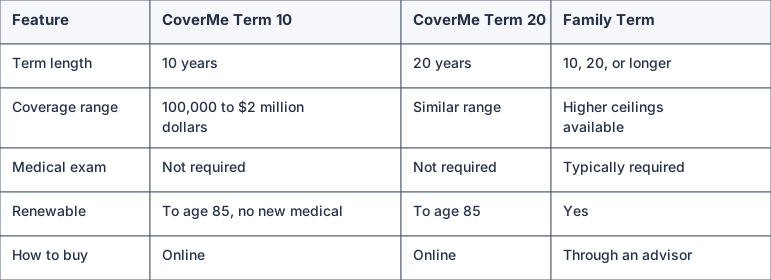
Manulife offers both advisor-sold and direct-to-consumer term products. Family Term, the flagship, is customizable with riders like disability waiver of premium, accidental death, and child coverage, and converts to permanent insurance without underwriting. For online buyers, the CoverMe platform offers two simplified-issue options:
Online convenience comes at a cost. Healthy applicants willing to complete a medical exam typically get better rates through Family Term or a broker comparison.
Each provider leans into a different strength, so the right fit depends on what the policy needs to do.
Its flagship term product, Evolve Term, is a fully underwritten policy (meaning it involves a full medical review) that covers up to $25 million dollars. That ceiling is what makes it useful for high-income earners, business owners who need enough coverage to fund a buy-sell agreement if a partner dies, and families with estates large enough to trigger significant tax on death.
Its main term product, called My Term, lets you pick any whole number of years between 5 and 50 as your coverage period. Every other major insurer limits you to fixed options like 10, 20, or 30 years. With My Term, a buyer with 23 years left on a mortgage can buy exactly 23 years of coverage instead of overpaying for 25 or leaving a gap with 20.
It offers two paths depending on how an applicant prefers to buy. CoverMe is Manulife's online platform selling simplified-issue term products, meaning you answer a short health questionnaire instead of taking a medical exam. Family Term is the advisor-sold flagship, which opens up higher coverage, more riders, and the Manulife Vitality program that can lower premiums based on verified healthy habits. Manulife also offers Guaranteed Issue Life, a small-coverage product that approves applicants regardless of health history, filling a gap most insurers do not cover at all.


Before committing to a 20 or 30-year policy, it is worth checking who the insurer is and whether they will still be around to pay the claim. Two independent signals help here: financial strength ratings and customer feedback.
Four major agencies rate Canadian life insurers: A.M. Best, Moody's, S&P Global, and DBRS Morningstar. A rating of A or higher signals the insurer has the capital reserves to meet long-term obligations, including death benefit payouts decades from now.
As of early 2026, the three insurers covered in this comparison hold the following ratings on their primary operating companies:

All three sit comfortably above the A threshold, which is why they dominate the Canadian market. Ratings can shift, so verify the current grade on each agency's website before publishing or before making a purchase decision.
Independent review aggregators like InsurEye, Trustpilot, and the Better Business Bureau Canada collect policyholder feedback. Three themes consistently surface:
Coverage amounts and term lengths are where buyers have the most room to customize. The standard minimum across all three insurers is $50,000 dollars, and ceilings range from $1 million dollars on simplified-issue online products to $25 million dollars on fully underwritten flagship plans.
Common term lengths are 10, 20, and 30 years, though Canada Life's "My Term" allows any whole number of years between 5 and 50, and Sun Life's "Evolve Term" extends to 40 years. A 20-year term is the most purchased length in Canada, typically because it aligns with a standard mortgage amortization or the years until young children become financially independent.
Riders are optional add-ons that expand what the policy does beyond the core death benefit. The four most commonly selected:
Riders add cost, so the value calculation is simple: include a rider only when the specific risk it covers is both plausible for the applicant and not already covered elsewhere, for example through a group disability plan at work.
The standard rule of thumb is 10 to 12 times annual income, but that number misses the point for most households. A more useful calculation adds up four inputs:
Subtract existing assets like savings, employer group life coverage, and other policies. The remainder is the coverage gap.
Advertised premiums are rarely the lowest rate an applicant can actually get. Three routes reliably reduce the cost:
Be cautious about "introductory" or first-year discounts. Some simplified-issue online products use teaser rates that step up sharply after year one, making the five-year cost higher than a standard fully underwritten policy.
Most Canadian term life applications now run through one of three channels:
Every application requires:
Fully underwritten policies above roughly $1 million dollars typically require a paramedical exam, conducted by a nurse at the applicant's home or workplace. The exam covers height, weight, blood pressure, and a blood and urine sample. Results take 2 to 6 weeks to finalize.
Switching is possible and common, usually driven by one of three motivations: finding a cheaper rate after improving health, needing more coverage after a major life event, or consolidating multiple small policies.
The critical rule: never cancel the old policy until the new one is in force. Life insurance underwriting is never guaranteed.
An applicant who cancels early and is then declined or rated up on the new application can be left uninsurable at the original rate.
The overlap between paying two policies usually lasts 4 to 8 weeks. Building that double premium into the budget upfront prevents the temptation to cancel early.
Switching resets the contestability period, and this matters more than most buyers realize. Every Canadian life insurance policy has a two-year clause during which the insurer can investigate and deny a claim if they find material misrepresentation on the application.
When you buy a new policy, that clock restarts from zero. A death in year 18 of the original policy is essentially untouchable by the insurer; the same death in year one of a replacement policy gets fully investigated.
If the existing policy is already past its two-year mark and still priced reasonably, the hidden cost of starting that clock over can outweigh a modest monthly premium saving on the new plan.
Term life insurance is one of the simplest financial products a Canadian household will ever buy, and also one of the most consequential. The right policy protects a mortgage, replaces lost income for 10 to 30 years, and removes a category of worry that would otherwise sit in the background of every family decision.
The wrong one (too little coverage, the wrong term length, or a rate that was never competitive to begin with) leaves a gap that only shows up at the worst possible moment.
The four things that separate a good policy from a mediocre one are straightforward: financial strength of the insurer, coverage amount matched to actual obligations, term length aligned to real timelines, and a premium that reflects the applicant's true underwriting class.
Getting all four right is mostly a matter of comparing carriers honestly rather than settling for the first quote that lands in the inbox.
PolicyNinja pulls real-time quotes from Canada's major term life insurers side-by-side, so you can see what each one charges for your exact age, health profile, coverage amount, and term length.
A licensed advisor walks you through the application from the first quote to the signed policy, with no fees and no obligation to buy. Most applicants get their first comparison in under three minutes.Compare your term life options on PolicyNinja →
The main benefit of term life insurance over whole life insurance is that it costs less. A term life insurance policy gives you a lot of financial security for a certain amount of time and has much lower premiums. This means that term insurance is a good choice for young families and people who want to take care of temporary costs, like a mortgage, without paying more for permanent coverage.
Yes. Every Canadian term life policy includes standard exclusions and limitation clauses. The most common are:
Exclusion lists are policy-specific and appear in the contract documents. Read them carefully, and ask your broker to flag anything unusual before signing.
Most Canadian term policies include a conversion privilege, letting you switch to permanent coverage without a new medical exam. Two important caveats apply. First, conversion must happen before the deadline set in your policy, typically age 65, 70, or 75 depending on the insurer. Second, the new permanent premiums are based on your age at the time of conversion, not your age when you originally bought the term policy, so the cost jump can be significant. Contact your insurer directly to request conversion paperwork and compare the permanent product options available to you before committing.

Cindy David, CFP, CLU, FEA, TEP, is President & Estate Planning Advisor at Cindy David Financial Group Ltd. in Vancouver. A recognized leader in wealth management and estate planning, Cindy guides clients with strategic, tax-effective solutions while championing innovation and women’s leadership in the financial industry. She is the former Chair of the Conference for Advanced Life Underwriting (CALU) — Canada’s professional association for senior life insurance and financial advisors that advances education, advocacy, and best practices in advanced planning and public policy.


